Circuito de Jerez Ángel Nieto
Jerez de la Frontera, Cádiz, Andalusia, Spain
Track
Automobile course with Ayrton Senna chicane
Provisional outline · © OpenStreetMap contributors · ODbL 1.0
- Lap length
- 2.751 mi4.428 km
- Turns
- 15
- Lap flow
- Clockwise
- Opened
- 1985
The Ayrton Senna chicane on the car course
Track details
Driving character
A mixture of slow corners and sustained medium-speed arcs makes the car’s balance and tyre condition easy to expose. Linked bends demand disciplined placement, and late braking alone does not produce a good lap. The car chicane adds a distinct technical interruption to the flowing motorcycle route.
Track specs and FIA listings
Layout & dimensions
- Venue type
- Permanent
- Published site area
- 279.2 acres / 113 ha
- Layout since
- 1994
Measurement notes
Selected car route is 4.428 km with the Senna chicane, introduced in 1994. Operator gives 4.423 km and 13 curves for the motorcycle route. The car course has 15 bends, nine right and six left. This count does not establish the name or number of each bend. Paddock area is not used as whole-site area.
Operator explicitly states 113 hectares for the total venue, distinct from the 48,294 m² paddock.
Other licensed configurations, where present, are retained in the FIA layouts register.
FIA configurations
Highest listed venue grade: 1. It does not apply to every layout. Within published expiry as of 17 Nov 2026. .
Published configurations and reference widths are separate from selected-layout measurements.
- JEREZ · Grade 1 · 2.751 mi / 4.428 km · Reference width 36.1 ft / 11 m · Listed expiry 2028-02-28 (Within listed expiry)
Driving assessment
- Driving demand
- 7/10
- Overall editorial score
- 7.25/10
- Editorial rank
- 56 of 113 assessed venues
Editorial score = 40% driving character + 35% heritage + 25% current prominence. All component scores 1-10. Higher difficulty is not included as a quality bonus. Rank ties share rank.
Editorial driving demand: 1-3 approachable; 4-6 intermediate; 7-8 advanced; 9-10 expert. Not an eligibility, licence or safety rating.
Editorial assessment: Historic Formula 1 and a long motorcycle Grand Prix tradition support heritage; current MotoGP and testing keep the technical layout relevant. These are not FIA ratings.
Layout notes
A testing lap with two published variants
The selected 4.428 km car version has primary technical support for fifteen corners. Eiffage’s contractor-authored resurfacing article separates the standard course’s thirteen bends, eight right and five left, from the chicane course’s fifteen, nine right and six left. Lamborghini’s Super Trofeo circuit page also gives fifteen corners. The operator identifies the Senna chicane as the automobile variation; the current FIA list retains 4.428 km.
The operator describes a mixture of slow, medium and fast corners used for machinery development and preseason testing. As an interpretation of that mix, the lap tests braking, balance and corner-exit preparation across several speeds. A fifteen-turn total does not by itself establish each numbered corner’s precise location or name.
Track tools
History & facilities
The Senna chicane distinguishes Jerez’s car course
Circuito de Jerez Ángel Nieto began racing on December 8, 1985, before all its buildings were finished. The selected automobile course is 4.428 km with the Ayrton Senna chicane. The familiar 4.423 km, thirteen-corner motorcycle circuit is a separate published version and should retain its own measurements and records.
Jerez de la Frontera and Andalusian motorcycling
The circuit grew from a strong local motorcycle tradition in Jerez de la Frontera, Cádiz. The operator recalls the Trofeo de la Merced street races of the 1960s, which brought Spanish and international riders to the city. The permanent venue gave that sporting culture a dedicated home and developed a parallel identity in car racing and testing.
From the first touring cars to Formula 1
- December 1985 A Spanish touring-car meeting inaugurated the working track while pits and race control were unfinished.
- 1986–1987 Formula 1 arrived in April 1986; the first motorcycle Grand Prix followed in 1987.
- 1992–1994 Reworking of the course preceded the addition of the Senna chicane for car racing.
- 1997 The European Grand Prix supplied a prominent Formula 1 championship-deciding chapter.
The working circuit and its Motor Museum
The guided-visit programme includes race control, the press room, conference facilities, the podium and the distinctive OVNI viewing platform. A museum visit can accompany a booked tour. These spaces explain the organization behind a race meeting as well as presenting its history; access depends on the operational programme rather than being open in every event window.
- Approximate venue age
- 41 calendar years in 2026
- Operating status
- Active
First race on 8 December 1985; formal Formula 1 inauguration followed in April 1986.

Sources & research notes
A new source for the circuit’s forty-year archive
The operator presents a 400-page anniversary book by Jesús Benítez, Álvaro Rivero and Raúl Zarzuela, bringing together extensive text, photographs and graphics. Alongside the museum, official history and media pages, it offers a strong lead for an expanded event and layout archive. The book description establishes its existence and scope, not access to its full contents or permission to reproduce them.
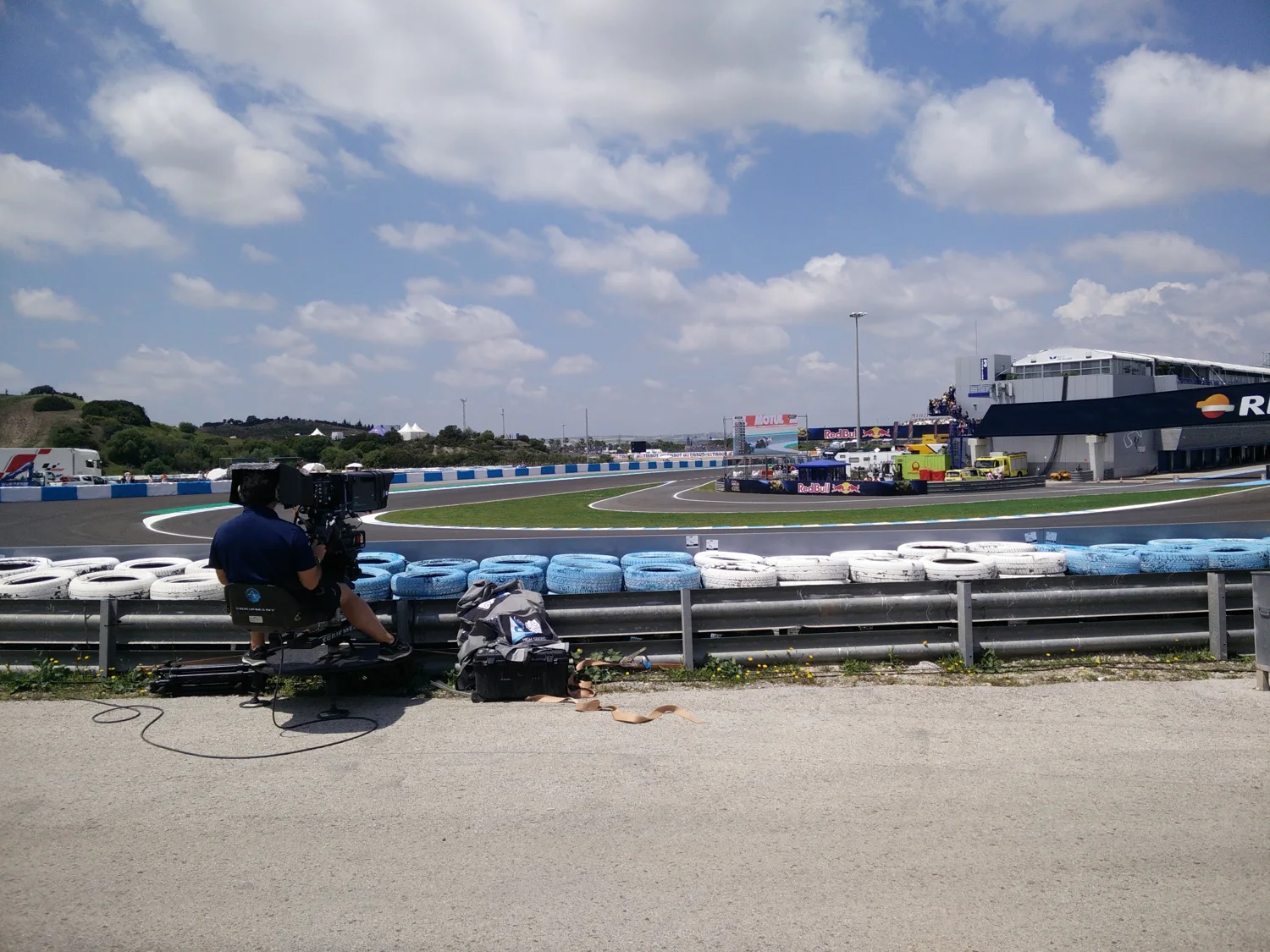
A trackside television camera at Jerez, 4 May 2018. The photograph documents that date, not the present layout or admission arrangements.
- Simulation — iRacing The official iRacing catalog and product page identify this venue as simulation content. The publisher describes the venue’s 15-turn route. The selected automobile route and its chicane usage still require a configuration-level match.
Evidence and open questions
Evidence confidence: High · Venue reference C018. Research as of 2026-11-17.
- Individual car-course corner numbers and names still require a dated numbered plan.
- A verified full minimum-to-maximum track-width range was not located.
- Comparable whole-lap elevation range not verified.
- Longest straight not verified for this exact layout.
- Coordinates not independently verified; city and venue identification supplied.
Article updated 2026-11-21.
Visitor guide notes
Advance-booked guided visits and museum limits are verified; race admission and accessible routing remain separate.
Review due 2027-01-15.
Sources
- Jerez circuit history and specifications · Circuito de Jerez Ángel Nieto
1985 first race, 1994 car chicane, route lengths, 113 ha total area and access Selected corner notes: Dry Sack.
- Spanish MotoGP 2026 · Circuito de Jerez Ángel Nieto
2026 MotoGP on the 13-turn motorcycle course
- September 2026 car-racing programme · Circuito de Jerez Ángel Nieto
2026 Porsche Sprint Challenge Iberica
- Lamborghini Super Trofeo Europe — Jerez circuit · Automobili Lamborghini / Lamborghini Squadra Corse
Championship manufacturer publishes 15 corners for its Jerez car course; rounded 4.4 km is not substituted for canonical 4.428 km.
- Jerez resurfacing contractor technical article — Carreteras 169 · Asociación Española de la Carretera; authors from Eiffage Infraestructuras
Contractor-authored table explicitly distinguishes normal 13 corners (8 right/5 left), 4,423.101 m, from chicane 15 (9 right/6 left), 4,427.995 m; historical technical reference, not a fresh survey.
- Guided visits and Motor Museum · Circuito de Jerez Ángel Nieto
Race control, pressroom, podium, OVNI viewpoint and event-dependent museum access.
- Fortieth-anniversary history book · Circuito de Jerez Ángel Nieto
400-page anniversary work by Jesús Benítez, Álvaro Rivero and Raúl Zarzuela; leads to historical photographs, not a licence.
- Circuit official homepage · Circuito de Jerez Ángel Nieto
Current programme entry points and distinct driving/event services.
- FIA licensed circuits — 4 November 2026 · Fédération Internationale de l’Automobile
Exact JEREZ ESP Grade 1, 4.428 km, expiry 28.02.2028, width 11 m row in the dated current licence list. Left/Right is pole position, not racing direction.
- Circuito de Jerez – Ángel Nieto — official iRacing track page · iRacing
Official iRacing venue appearance and only the explicitly described configuration/era caveats; not a real-world survey or current sporting-status source.
- Historical photograph: A trackside television camera at Jerez, 4 May 2018. · Ismcuacor / Wikimedia Commons
Original file description, author, capture date and licence
- Jerez: Super Trofeo Europe PRO/PRO-AM qualifying 1 final results · Lamborghini Squadra Corse / Perugia Timing
Final classification dated 14 November 2024, 4,428 m map header and overall first row
- Dry Sac officially named for Dani Pedrosa · MotoGP
Selected corner notes: Dani Pedrosa corner.
- Visitas guiadas · Circuito de Jerez S.A.
Advance appointment, operational exclusions, museum-only event-shop limit and tour areas.
- FIA licensed circuits roster, 2026-11-04
Corners
Corner highlights
Ayrton Senna chicane
The automobile course adds a change of direction here. It has 15 turns; the standard route without the chicane has 13.
Dani Pedrosa corner
This bend was still known as Dry Sack when Michael Schumacher and Jacques Villeneuve collided here in the 1997 title decider. It was named for Dani Pedrosa in 2019.
Videos
 Watch on YouTube
The Senna chicane in a Ferrari 458 Challenge
Onboard lap · Jerez car course · October 2016
What to watch for
Nico Verdonck · Follow Holger Harmsen into the Ayrton Senna chicane. The quick change of direction identifies the car configuration described in the profile.
 Watch on YouTube
Dylan Gray on the Jerez motorcycle course
Motorcycle onboard · MotoGP · Jerez motorcycle configuration
What to watch for
MotoGP · Follow the bike through the fast right-handers late in the lap. The motorcycle course sweeps through the section where the car route adds the Ayrton Senna chicane.
 Watch on YouTube
José Luis Cardoso shows the line from behind
Rear-facing coaching lap · Jerez motorcycle course · Spanish riding-school session
What to watch for
JOSE LUIS CARDOSO · Watch Cardoso’s body position and the kerbs slipping away behind him. The rear view shows where the bike finishes each turn across the width of the track.
Visit
A guided visit requires a confirmed appointment requested at least 24 hours beforehand.
Viewing and admission
The booked tour describes the podium and OVNI viewing platform among operational areas; this is not a race spectator ticket or unrestricted platform access.
Not confirmed
Which race ticket and grandstand have a verified gate connection?
Conditions and restrictions
Guided visits need an appointment requested at least 24 hours before the start and are unavailable during specified official competitions or closed-door events.
Not confirmed
Which operational closure affects the proposed appointment?
Visits and driving outside races
A museum visit can accompany a guided tour. Museum-only access is limited to announced event days when the shop opens, rather than a daily walk-in service.
Not confirmed
Has the requested tour date and museum inclusion been confirmed?
Not confirmed
Some arrival details are unconfirmed
Arrival and entry
Where is the tour meeting point, and how is it reached from parking or public transport?
Camping and where to stay
What event camping permission and accommodation-area route apply?
Complete accessible route not confirmed
Accessible visits
Can the booked tour, including OVNI, be completed step-free?
Food and facilities
Which toilets and refreshments are open during a guided visit?
Access notes
Partial guide · Last reviewed 2026-11-18
Guided visits require an advance appointment requested at least twenty-four hours before the start. They are unavailable during certain official or closed-door events. The main website separately lists 2026 car and motorcycle sporting sessions, so participants should choose the appropriate programme and confirm its vehicle, route and organizer requirements.
Event access; private driving or track-day eligibility must be checked with the operator.
Events
2027
15–17 Jan 20274 Hours of Jerez — Asian Le Mans Series
The winter series brings two four-hour races to Jerez between Le Castellet and Portimão.
Automobile Club de l’Ouest · 2026/27 Asian Le Mans Series7–9 May 2027MotoGP Spanish Grand Prix
Jerez hosts the Spanish Grand Prix before the championship travels to Le Mans.
MotoGP · 2027 Grand Prix scheduleRaces & lap times
Signature race European Grand Prix (1997)
Motorcycle Grands Prix and a continuing car programme
The 1986 Formula 1 debut produced the close Senna–Mansell finish recalled in the operator’s history. Contemporary motorcycle racing remains central, with the 2026 Spanish MotoGP event listed separately. The September 2026 car programme includes Porsche Sprint Challenge Iberica, demonstrating continuing car use without implying that its session map is identical to the motorcycle course.
Selected timed laps
Jerez 4.428 km car course with Senna chicane. Fastest in this classification only; not an all-time circuit record.
| Time | Class / session | Driver | Team / car | Event / date | Scope / evidence |
|---|---|---|---|---|---|
| 1:56.850 | Lamborghini Super TrofeoQualifying · PRO/PRO-AM qualifying 1 | Frederik Schandorff | Target RacingLamborghini Huracán ST EVO 2 | Lamborghini Super Trofeo Europe – Jerez2024-11-14 | Jerez 4.428 km car course with Senna chicane.Fastest in this classification only; not an all-time circuit record. |
Original research snapshot · 17 November 2026
Race history
The track held its first race on 8 December 1985, before the buildings were complete; Formula 1 followed in April 1986. Its first motorcycle Grand Prix came in 1987. The course was reworked in 1992, then the Ayrton Senna chicane was added for car racing in 1994. Formula 1’s 1997 European Grand Prix championship decider forms a prominent part of its car-racing history.
Current uses
The operator’s 2026 programme confirms MotoGP and a September Porsche Sprint Challenge Iberica meeting. Track hire, testing, driving courses and public sessions are also offered. The selected automobile route uses the Senna chicane; the familiar 13-turn MotoGP description applies to the slightly shorter motorcycle configuration and is not silently reused here.