Hockenheimring Baden-Württemberg
Hockenheim, Baden-Württemberg, Germany
Track
Grand Prix circuit
Provisional outline · © OpenStreetMap contributors · ODbL 1.0
- Lap length
- 2.842 mi4.574 km
- Turns
- 17
- Lap flow
- Clockwise
- Opened
- 1932
The Parabolika hairpin and Motodrom stadium
Corners
Corner highlights
Parabolika and the hairpin
The long acceleration through the Parabolika sets up heavy braking at the hairpin. The turns of the Motodrom are much closer together.
Motodrom
The stadium sequence opened in 1966, when motorway construction forced the circuit to change shape.
Videos
 Watch on YouTube
Tim Zimmermann explains Hockenheim
Narrated onboard · Porsche Carrera Cup Deutschland · 2019 guide
What to watch for
Porsche Sixt Carrera Cup Deutschland · Follow the long acceleration along the Parabolika into the hairpin. Compare that approach with the short gaps between turns in the Motodrom.
 Watch on YouTube
A DTM race from Rockenfeller’s seat
Touring-car race onboard · 2015 DTM Hockenheim · Race 2
What to watch for
DTM · Start with the opening lap from pole. Watch how much room the field has at the hairpin and how quickly that room disappears in the stadium section.
 Watch on YouTube
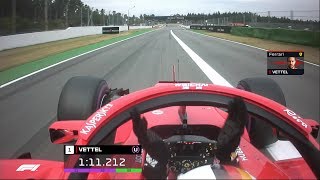
Vettel’s Ferrari pole lap at home
Qualifying onboard · 2018 German Grand Prix
What to watch for
Formula 1 · Track the steering from the long curve of the Parabolika into the hairpin. Compare the heavy braking there with the flowing turn into the stadium.
Visit
Visits depend on an advertised event or booked experience; directions do not confer entry.
Viewing and admission
The South Grandstand wheelchair positions are behind the top seating row. Ask for blocks C/D when arranging tickets rather than buying an arbitrary seat in the stand.
Not confirmed
Which places remain available for the selected meeting? South Grandstand blocks C/D and toilets in the Welcome Centre and drivers’ camp.
Arrival and entry
The circuit provides motorway approaches from A6, A61 and A5. Hockenheim station is served from Mannheim and Karlsruhe; station shuttles are described for major events, not as a daily connection.
Some arrival details are unconfirmed
Not confirmed
What shuttle operates on the actual event day and where does it drop visitors?
Accessible visits
For racing events the operator directs wheelchair users to the South Grandstand, blocks C/D. Companion seating is in the top row in front of the wheelchair positions; companion prices depend on the event.
Complete accessible route not confirmed
Not confirmed
Which arrival and return route connects the booked block to the accessible car park?
Food and facilities
The accessible toilet at the Welcome Centre by the main stand does not need a Euro WC key during regular opening hours. The drivers’ camp and ground-floor Baden-Württemberg Centre facilities use that key.
Not confirmed
Which facilities will be open during the booked session?
Conditions and restrictions
Parking areas include meadows and gravel, and stewards allocate spaces according to availability; the operator recommends suitable footwear.
Not confirmed
Which event bag, re-entry and shelter rules supplement the parking-surface warning?
Visits and driving outside races
Insider Tours and separately advertised driving experiences are the non-race options already documented; access to working areas remains conditional.
Not confirmed
Which Insider Tour date is bookable and which areas are included?
Not confirmed
Camping and where to stay
Is camping permitted for this visit, and how does it connect to the selected stand?
Access notes
Partial guide · Last reviewed 2026-11-18
Insider Tours visit grandstand viewpoints, the paddock and podium, with a track tour subject to operational availability. Advance registration is required. Tourist driving, instructed experiences and race-taxi rides are separate products; visitors should check the selected activity’s current booking arrangements and the event-specific parking and access instructions.
Event access; private driving or track-day eligibility must be checked with the operator.
Events
2027
7–9 May 2027ADAC Hockenheim Historic
The Jim Clark Revival brings historic racing back to the circuit where Clark last competed.
Hockenheimring · Jim Clark Revival8–10 Oct 2027DTM season finale
Hockenheim hosts the final DTM meeting after a season that opens at Spielberg.
Hockenheimring · DTM finaleRacing history
Signature race German Grand Prix (historical)
Grand Prix heritage and a current DTM finale
Formula 1 belongs to Hockenheim’s established sporting history. More recent competition is documented by the operator’s October 12, 2026 DTM report: Maro Engel won the season’s final race, while Thomas Preining secured the championship with third place. This is evidence of completed contemporary GT3 racing, rather than a calendar-only appearance.
Original research snapshot · 17 November 2026
Race history
Motor racing began here in 1932. The venue evolved from a long forest circuit into a major German Grand Prix location, with the stadium section creating a particularly distinctive spectator setting. The 2002 reconstruction shortened the route substantially and replaced the long forest straights with the present course. The older track and the modern 4.574 km Grand Prix layout should therefore be treated as different generations of the same venue.
Current uses
The operator’s dated October 2026 report confirms the DTM season finale at Hockenheim. Its broader programme includes national and international racing, testing, corporate hire and public driving activities. The historic Formula 1 association remains important, but it is not listed as a 2026 Formula 1 race venue.